
Professional Business Card Design – Why It Still Matters in a Digital World
Professional Business Card Design
In a marketplace dominated by websites, social media platforms, and digital advertising channels, it is easy to assume that traditional business cards have become obsolete. Yet despite rapid technological evolution, business card design remains one of the most powerful and immediate tools for establishing credibility. A professionally designed business card is often the first tangible representation of a brand that a potential client holds in their hands. That physical interaction creates an impression that digital communication alone cannot replicate. When designed intentionally, a business card reinforces brand identity, strengthens recognition, and communicates professionalism in a matter of seconds.

Business card design is not simply about placing contact information on a small rectangle of paper. It is about presenting a structured brand identity in a condensed format. Every design choice – from typography and spacing to color balance and logo placement – communicates something about the business. A well-executed design signals attention to detail and organizational maturity. A poorly executed one can quietly undermine trust before a conversation even begins.
Why Business Card Design Still Matters
Even in a digital-first environment, business cards continue to serve an important role in networking, sales meetings, conferences, trade shows, and client consultations. They offer an immediate exchange of information without the friction of device compatibility, internet access, or battery life. More importantly, they create a physical anchor for brand memory. Research in cognitive psychology consistently shows that tactile experiences improve recall. When someone physically receives a business card, the brand becomes associated with that interaction in a more memorable way.

Professional business card design also enhances perceived legitimacy. When meeting potential partners or clients, the quality of presentation often influences confidence. A thoughtfully designed card demonstrates that the business values its image and invests in cohesive branding. In industries where trust and reliability are critical, that subtle reinforcement can influence decision-making.
Conversely, generic or cluttered designs can create doubt. Cards overloaded with information, mismatched fonts, inconsistent colors, or low-resolution logos can signal disorganization. Even if the business itself operates at a high level, the visual presentation may unintentionally suggest otherwise. Business card design therefore functions as a silent ambassador for the brand.
What a Business Card Represents
A business card is a condensed brand system. Within a limited physical space, it must communicate identity, hierarchy, clarity, and professionalism. The logo anchors the card visually and establishes brand recognition. Typography reinforces tone and personality. Spacing and layout contribute to readability and balance. Even paper stock and finish influence perception.

Over time, business cards accumulate meaning through repeated interactions. When a company consistently delivers quality service and professionalism, the card itself becomes associated with reliability. Clients who revisit the card months later often recall the experience of the initial meeting. That repetition strengthens familiarity. Familiarity reduces perceived risk and increases confidence in future engagement.
For small businesses and startups, this effect can be especially powerful. Without decades of reputation behind them, newer companies rely heavily on presentation to signal seriousness and stability. A professional business card can accelerate credibility in situations where first impressions carry significant weight.
The Strategic Elements of Effective Business Card Design
Professional business card design incorporates several foundational principles that determine how effectively the card performs in real-world use. Simplicity remains one of the most important. A clear layout ensures that essential information stands out. Overcrowding the card with excessive details reduces readability and weakens impact. Strategic restraint often produces stronger results than attempting to include every possible piece of information.
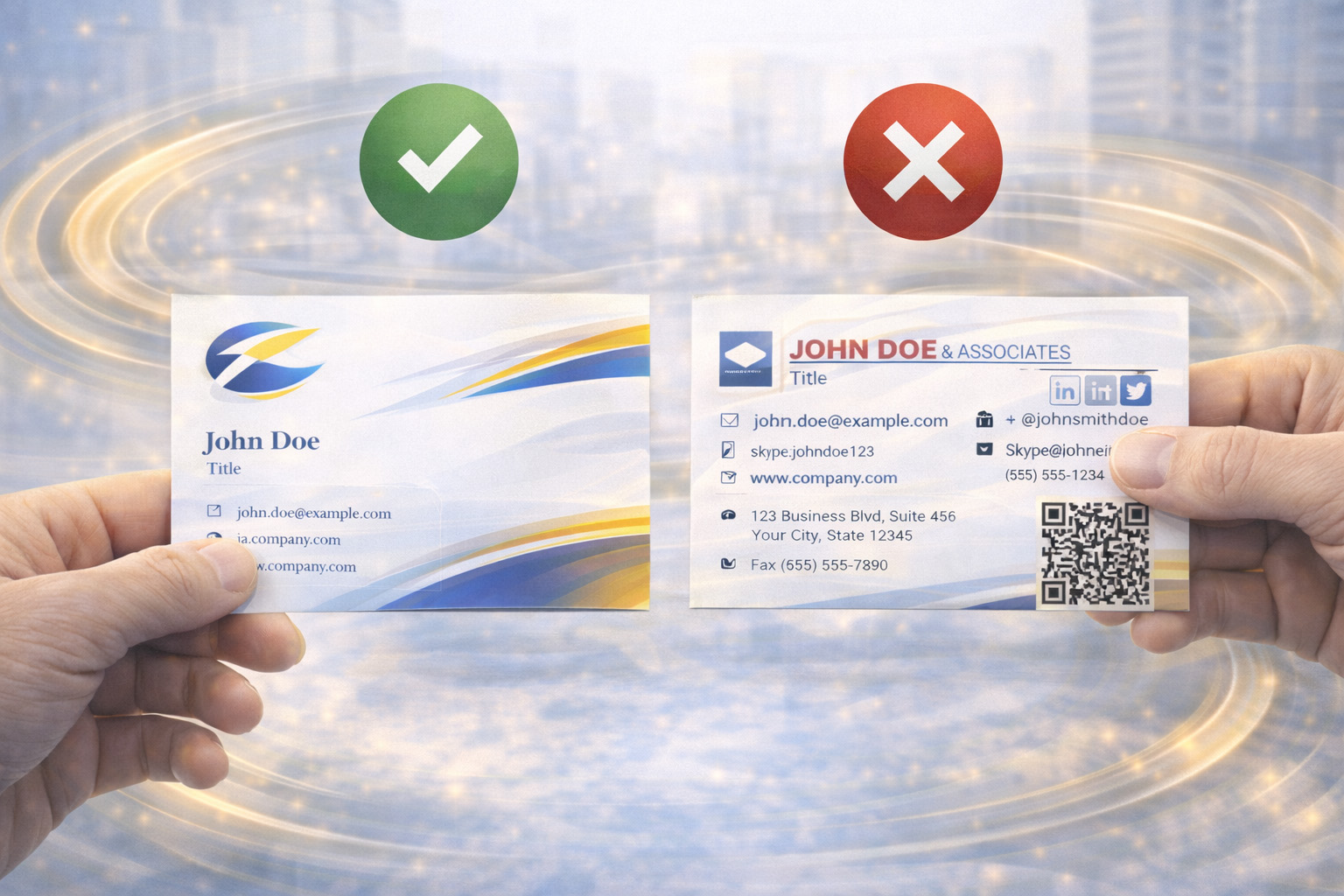
Hierarchy plays an equally important role. The viewer’s eye should naturally move from the logo to the individual’s name, then to the role or title, and finally to contact details. This structured progression creates clarity. Without hierarchy, information competes for attention and becomes difficult to process quickly.
Consistency with existing branding is also critical. The card should align seamlessly with the company’s logo, website design, color palette, and typography system. Inconsistencies create fragmentation. When visual elements remain unified, brand recognition strengthens across all touchpoints.
Scalability and print readiness are additional considerations. Files must be prepared correctly for professional printing, with proper bleed settings, color profiles, and resolution. Neglecting these technical aspects can result in blurry logos, misaligned edges, or color inaccuracies. Professional design ensures that the final printed product matches the intended visual identity.
Business Cards as Brand Authority Tools
Brand authority develops through repetition and cohesion. Each time a business card is exchanged, it reinforces the same visual identity. Over time, this repetition builds familiarity. When clients encounter the same logo, typography, and color system across business cards, websites, proposals, and email signatures, the brand feels organized and intentional.

Authority is often built in subtle ways. A business card handed over at the end of a productive meeting becomes a reminder of competence. If that card reflects structured branding and thoughtful design, it strengthens the association. When clients later search for the business online and encounter consistent visual presentation, the brand appears established and credible.
This continuity also influences internal culture. Teams who use professional materials tend to feel more confident presenting themselves. That confidence can translate into stronger communication and improved client interactions.
The Risks of Generic Templates
Many businesses initially rely on downloadable templates or quick online generators for business card creation. While these tools provide convenience, they often lack customization that aligns with a company’s broader brand identity. The result is visual inconsistency.
Generic templates frequently use standard fonts, stock layouts, and color combinations that do not reflect the unique positioning of the business. Logo placement may be awkward. Spacing may feel cramped. Typography may conflict with website branding. Although these issues may seem minor, they collectively weaken brand cohesion.

Inconsistent presentation can create confusion. When a client receives a business card that looks disconnected from the company’s website or marketing materials, the brand loses clarity. Cohesion builds recognition. Fragmentation reduces it.
Upgrading from generic templates to custom business card design often produces immediate improvement. The brand feels unified. Visual communication becomes intentional rather than improvised.
How Professional Business Cards are Developed
A structured design process increases the likelihood of achieving a strong final result. Rather than simply placing contact details into a preset layout, professional designers evaluate brand positioning, audience expectations, and intended usage scenarios.
The process begins with alignment to the existing logo and brand system. Designers evaluate color palettes, typography standards, and established visual direction. From there, layout options are explored to determine how information can be presented clearly while maintaining aesthetic balance.

Typography selection is guided by readability. Name prominence is calibrated carefully. Contact details are organized logically. Spacing is refined to avoid crowding. Front and back designs are considered in relation to one another, ensuring that both sides work together cohesively if a double-sided format is used.
Technical preparation follows design approval. Files are formatted for professional printing with proper resolution, bleed margins, and color accuracy. Deliverables are prepared in formats that allow for easy reprinting without additional design adjustments.
The objective is not merely to produce an attractive card. It is to create a professional tool that consistently reinforces brand identity.
Business Cards Within a Broader Branding System
Business card design works most effectively when integrated into a larger branding framework. The visual direction established by the logo should carry through to letterhead, envelopes, invoices, email signatures, and website design. Each asset reinforces the others.

When branding elements remain unified, future materials become easier to develop. Established layout principles simplify design decisions. Teams can create new documents or marketing collateral without compromising visual alignment.
This cohesion strengthens recognition over time. Clients encounter consistent branding across every interaction. That consistency builds trust and authority incrementally.
When to Introduce or Refresh Business Cards
Businesses often consider custom business card design during periods of transition. Launching a new company, rebranding, updating a logo, expanding into new markets, or refining service offerings can all justify revisiting card design.

Upgrading outdated cards can also signal growth. Visual styles evolve gradually. A design that felt modern ten years ago may now appear dated. Refreshing presentation demonstrates attentiveness and adaptability.
However, redesign decisions should remain strategic rather than trend-driven. Maintaining continuity is valuable unless the existing design presents clear limitations. The goal is refinement and alignment, not constant reinvention.
The Long-Term Value of Professional Business Card Design
Compared to large-scale advertising campaigns, business card design represents a modest investment. Yet its impact extends into every professional interaction. Each networking event, client meeting, or partnership discussion presents an opportunity to reinforce brand identity through physical presentation.
A well-designed business card does more than share contact information. It communicates professionalism, clarity, and confidence. It supports brand recognition. It strengthens memory retention. It builds subtle authority through repetition.
Over time, these small impressions accumulate. Brand equity grows not only through marketing visibility, but through consistent presentation across every touchpoint. Business card design remains one of the most compact yet influential components of that system.
When executed thoughtfully and aligned with broader branding strategy, a business card becomes more than paper. It becomes a structured representation of the organization itself.

Business Card Design
Your business card should match your logo and your website – clean, sharp, and confident.